Showing posts with label parangal. Show all posts

Parangal 2019 held in the 7-12 Gymnasium


Last May 10, 2019, at the University of the Philippines Integrated School (UPIS) 7-12 High School Building Gymnasium, the Parangal 2019 was held with a theme of “Malayang Islokar, Tumitindig para sa kasarinlang Iniibig”.

During the program, outstanding students in academics and sports from grades 7-12 for the current academic year of 2018-2019 were given recognition. It began with opening remarks by Principal Lorina Y. Calingasan, followed by guest speaker, Dr. Rommel B. Rodriguez of UPIS Batch 1993 from the U.P. College of Arts & Letters who delivered a speech about how the youth should voice their emotions about the current national issues. There were also various special numbers that were performed by both the UPIS choir and Jarod De Luna, Academic Excellence Awardee for Music, Grades 7-12.

HARMONY. Voice Music class of 2019 performing in front of the 7-12 student body, teachers, and students. Photo Credit: Sophia Loriega

The Huwarang Mag-aaral Awardees from Grades 7-12 are as follows (in order): Maria Bautista, Erielle Arceo, Cynarina Licuanan, Robert Ambat, Rizza Cabrera, And Roan Ticman.

Reine Cruz, Abbie Cuaresma, Bianca Baguio, Onise Manas were awarded Pinakamahusay na Lider from grades 7-9 and Reneil Grimaldo, who also won the Gerry Roxas Leadership Award, was awarded Pinakamahusay na Lider for Grade 10.

AWARDEES. Huwarang Mag-aaral Awardee Robert Ambat and Pinakamahusay na Lider Awardeen Reneil Grimaldo pose for photos in front of the stage. Photo credit: Sophia Loriega

The Closing Remarks were given by Roan Ticman. In her speech, she talked about how the students of UPIS should fight for our rights and voice out our emotions so that it will reach the administration.

SPEECH. Roan Ticman gives her speech in front of the 7-12 student body, teachers, and guests. Photo Credit: Sophia Loriega

The Parangal for Grade 3-6 and K-2 were held later on the day. //by Sophia Loriega & Roel Ramolete

Parangal 2018 Speech of Dr. Diego Silang S. Maranan


Photo Credit: Prof. Anthony Joseph Ocampo 


Good morning everyone. I’m thrilled to be here. Today you are being recognized for your outstanding academic performance. That is an amazing accomplishment, and you should feel good. I remember feeling good when I was sitting as you sit now. UPIS shaped me profoundly, in ways that I may not even begin to understand, but for which I will be eternally grateful. When I was at UPIS, I learned the value of getting along with classmates from all walks of life, about valuing knowledge and creativity. I also learned how to be a bit rebellious and contrarian, unfortunately sometimes to the point of being offensive. The last time I spoke at a UPIS event, I was the class valedictorian delivering the graduation address, where I pretty much criticized my teachers and defended my batchmates, who at that time I thought were being unfairly and routinely castigated by the teachers. I think about that time now with some embarrassment. But resisting authority is something that I learned in UPIS. I’ve just become a bit more subtle in my resistance.

And I’m going to resist a little bit this morning. I was asked to address the theme, “Iskong mahal ang bayan, manindigan para sa katotohanan.” “Love your country, stand for the truth.” And I want to respond to the idea by unpacking and resisting it a bit. How do you know what is true? How do you stand for the truth? And what does this have to do with loving your country?

How do you know what is true? Let me try to answer this in a roundabout way. The truth comes in many shapes and sizes. Many of you have heard the term “fake news” by now, and it’s an indication of just how complicated the truth is in today’s world. There are simple cases of the truth. There are less than 1000 people in this room: that’s undeniably true. The temperature outside is 29 degrees Celsius: that’s also true more or less, depending on whether you’re measuring the temperature under the shade. The temperature outside is uncomfortably hot: well, that’s true for many people, but not for others. And that’s where it begins to get tricky, figuring out what people believe to be true for them. Here’s the thing. The more I go through life, the more I travel the world and speak to different people, the more I realize that actually, most people are already standing for the truth. Their truth. But the problem is that their truth is not always the same as yours.

When I was in the tenth grade at UPIS, one of my classmates and best friends, Denise Peña, gave me a book called “The Seven Habits of Effective People” by Stephen Covey. It was partly a self-help book and partly a guide to business leadership. It was a good book, one I think is still worth reading. Anyway, one of the seven principles was, “Seek first to understand, then to be understood.” What Covey meant by this was that before you try to get your point across, make sure you really understand where everyone else is coming from. Really come to grips with what it is that people believe in and why they believe it. And here’s the key: Listen particularly to those people whose ideas you disagree with. In fact, the more passionately you disagree with them, the more closely you have to listen.

And listen not necessarily because you want to attack their ideas, but because you listening to others encourages them to listen to you (as another UPIS batchmate, Thalia Valerio, pointed out to me). I was part of a debating club when I was in UPIS. I competed in inter-school debates. I think I may have even won a couple of them, although I honestly can’t remember. And frankly, I don’t really care, because sometimes I think the whole debate format can actually be harmful to the truth. In a typical debate, you are asked to pick a side (or you are assigned a side), you construct a series of arguments that support your side, and then you poke holes in your opponent’s arguments until you obliterate them. Even when your opponent makes valuable points, you are expected never to concede. You know what you will never hear someone say in a debate? “Oh, actually, that’s a good point. Now I need to revise my beliefs.” How does intellectual stubbornness serve the truth?

Photo Credit: Gian Palomeno


You could argue that a school debate is just an exercise in critical thinking, and that in real life people don’t really act that way. But that’s not true. We see the debate format played out everywhere, from everyday life at home, to the big arena of politics, in the Philippines but also elsewhere in the world. And in every debate, the goal of the debater is to assert that they are right and that their opponents are mistaken. On every count. That’s not always helpful. (I think the country, and the world for that matter, would be better served we had have more of what I think of as “anti-debates”. The way I have it in my mind, in an anti-debate, the winner is the person who manages to change their mind the most often, the one who can revise the most number of their opinions based on their opponents’ arguments…)

Which leads me to that question of standing for the truth. How do you stand for the truth? Or, as I prefer to think of it, how do serve the truth? I think that to really serve the truth, your job is actually not to protect your beliefs. Your job is to keep your mind open. To entertain possibilities, to examine evidence of all sorts. To exercise critical thought, yes, but also to suspend judgment for as long as possible. To explore and live in the uncomfortable gray zone of confusion. Confusion is not a bad thing. My favorite philosopher and explorer of the body and the mind, Moshe Feldenkrais, once said, “Confusion is a high state of being.” Because when you are confused, you are perceiving an alternative to your reality, to your truth.

When I graduated from UPIS, I had a very confusing choice. I didn’t know what to study in college. I had a fantastic offer to do the Intarmed medical program at UP Manila, which I rejected because I thought I hated medical science. I was accepted to UP Diliman, and I was trying to choose between physics or music. I told one of my batchmates my dilemma. And do you know what she said to me at the time? She said, Huwag mong piliin ang music. Sayang ang talino mo. “Don’t waste your intelligence on music.” And the ridiculous thing was that she herself was an artist! Unfortunately, I listened to her, and it took me 10 years to realize that that truth was not the only truth. In the end, I ended up studying computer science, but also dance, and later on also physics, and music, and neuroscience. But that’s another story. What is relevant is that along the way, I discovered a truth about art. Art can entertain; art can you make happy; art can make other people happy. But art can do so much more. Art and artists can encourage people to perceive things in a different way, challenge our ideas about our truth, provoke and cultivate curiosity. And to serve the truth, your job is to be curious—about as many aspects of the world you live in: be curious about the people around you, the things that you touch and use everyday, be curious even about the reality that you can’t perceive, like the reality on the level of atoms or of the cosmos… And above all, be curious about yourself: do you know yourself? How is it that you make decisions? How do you react to conflict? How do you react to unfamiliar situations? And how can you choose to choose differently? To stand up for the truth, you need be passionately curious, not passionately defensive. To serve the truth, you need to allow yourself to be surprised.

So. How do you know what is true? First, try to understand other people’s truths. What does serving the truth mean? I think it means keeping your minds, your bodies, and your hearts open and curious. And I think that this is what loving your country is ultimately all about: it’s about staying in the challenge of making sense of everyone else’s truth, even when it’s difficult… and especially when it’s difficult. It’s about celebrating diversity, and finding the things you can agree on, and building on the things that you do have in common. I think standing for the truth is about always finding new ways of understanding the world. And this is my final, rebellious point for this morning: To love your country, you might have to look beyond its borders. If you are able to, don’t be afraid to leave the Philippines. I did, when I was 17, straight out of UPIS, on my own and without the company of my family. But don’t be afraid to come back, if you can. I did, ten years later. And if you are able to, don’t be afraid to leave again, and come back again, and leave again and come back again. That’s what I do. Because we have as much to offer the world as much as the world has to offer us. And right now, we have only one world. And it’s in trouble. We’re in trouble. There is beauty and wonder, and misery and suffering, here in the country and elsewhere as well. I don’t love my country: I love the living beings who live in the country, and because I know them well, I stay here because I can create positive change in the Philippines. And loving the living beings in this country doesn’t prevent me from loving other living beings elsewhere in this vast, beautiful, curious, surprising world that needs you: this is the truth that I would like offer you this morning.

Thank you for your time. Have a curious day and have a surprising life.


Dr. Maranan is a member of UP Integrated School Batch 1996 and currently an Assistant Professor at the Faculty of Information and Communication Studies, UP Open University. For more details about him and his work, you may visit his website: http://www.diegomaranan.com/

For the video of his speech, you may go to this link: https://www.facebook.com/OfficialUPIS/videos/2066743876874286/


Mga Isko at Iska, hinikayat na manindigan para sa karapatang pantao


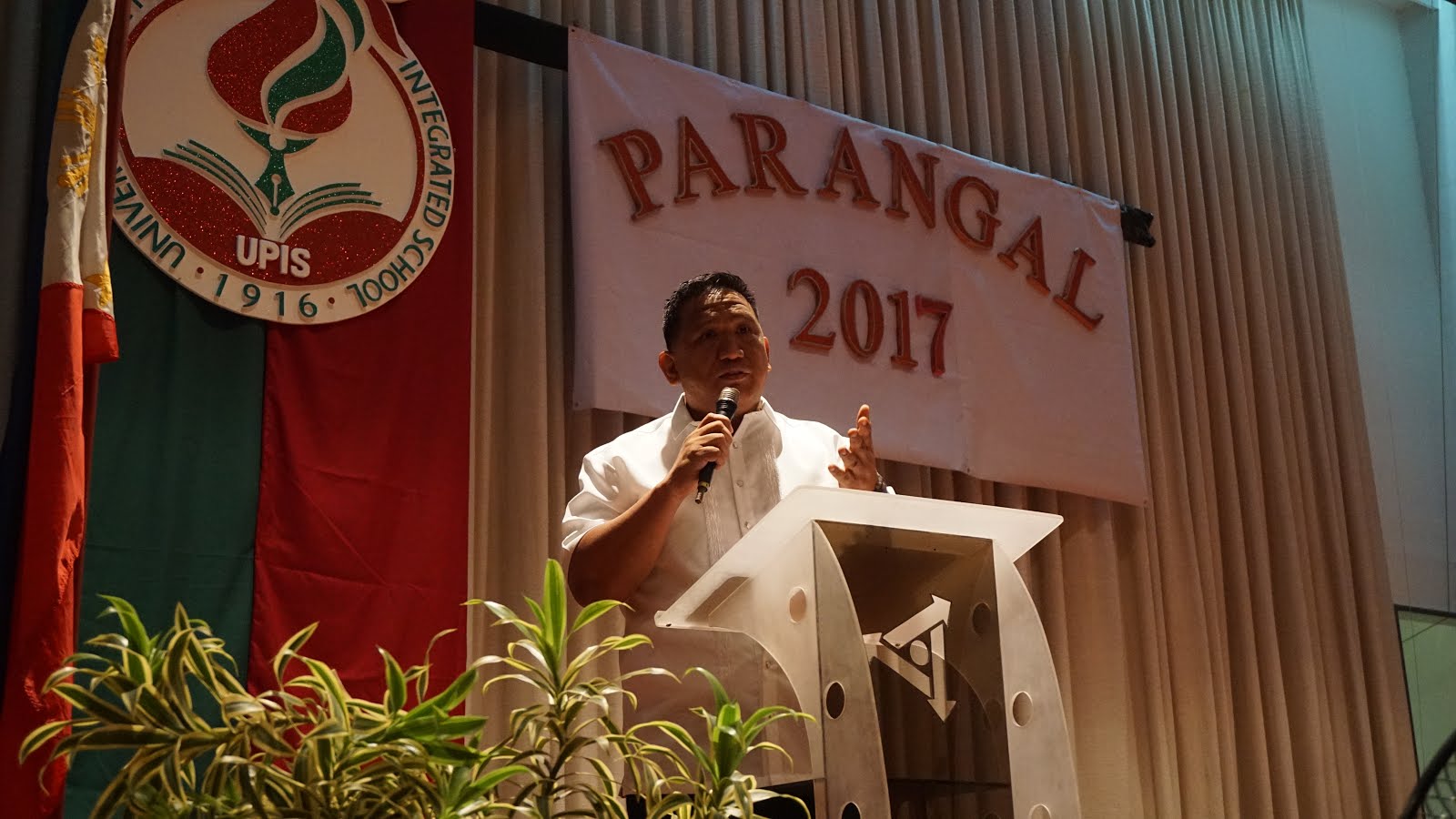
Idinaos ang UPIS Parangal 2017 sa UP National Institute for Science and Mathematics Education Development (NISMED) Auditorium noong Mayo 5.

“Iskolar ng Bayan, Manindigan para sa Karapatang Pantao” ang naging tema ng Parangal sa taon na ito. Nagbigay ng talumpati si Prop. Ranjit Singh Rye na isang propesor ng Political Science sa UP Diliman College of Social Sciences and Philosophy at alumnus ng UPIS. Si Prop. Rye ay kabilang sa Batch 1988.

Sa kaniyang pahayag, ibinahagi niya ang kaniyang mga naging karanasan sa panahon ng Martial Law. Nag-iwan rin siya ng hamon sa mga mag-aaral na manindigan at makibahagi sa pagbabago sa bayan.

PAGHIMOK. Ibinahagi ng panauhing tagapagsalita na si Prop. Ranjit Singh Rye ang kaniyang mensahe sa mga mag-aaral ng 7-11. Photo Credit: Media Center 

Tumugon naman sa paunang talumpati si Wenona Dawn Catubig, Huwarang Mag-aaral ng Grado 10. Binigyang pansin ni Wenona ang kahalagahan ng pagiging mulat sa mga isyung panlipunan gaya ng extrajudicial killings at kung paano nito nilalabag ang ating karapatang pantao. Isinalaysay din niya ang mga karanasan niya tungo sa pagkamit ng kaniyang parangal.

Isinagawa rin sa parehong araw ang pagbibigay ng parangal sa mag-aaral sa K-2 at Grado 3-6.//nina Enzo Bautista, Cedric Jacobo at Beca Sinchongco

UPIS holds Parangal 2016

Outstanding students in academics and sports as well as the best student leaders and model students in each grade level for AY 2015-2016 were recognized in the annual Parangal program held March 4 at the Auditorium.

In celebration of the school’s centennial, this year’s Parangal theme was Isang Siglong Dangal at Husay, Paigtingin ng Iskolar ng Bayan. Atty. Rommel Casis of UPIS Batch 1991, the guest speaker for Parangal 7-10, talked about how one should find ways to be the best version of himself/herself while being honest and true to oneself.

HONOR AND EXCELLENCE. Guest speaker Atty. Romel Casis delivers his speech
before the awardees of Grades 7-10. HANNAH MANALO
Senior Marianne Sasing, who has been Batch 2018’s recipient of the Model Student award since she was in Grade 7, also talked about how a student should have honor and excellence but should value the former more than the latter. As this year’s Grade 10 Leadership awardee, Sasing is also the recipient of the Gerry Roxas Leadership award.

The Parangal for 3-6 and K-2 were also held on March 4. / with reports from Rad Pascual

UPIS honors outstanding students, leaders in Parangal 2015

Last Friday, March 6, 2015, the most outstanding students and student leaders were recognized and awarded in the annual UPIS 7-10 recognition day.

This year's Parangal was held at the Auditorium and the whole student body and faculty, as well as the awardees’ parents, attended the event.

Prof. Carlene Pilar-Arceo, a UPIS alumnus and a UP faculty member, gave an inspiring message on this year's theme, Kabataan, Manindigan sa Matapat na Paglilingkod sa Bayan. She also regaled the audience with stories and anecdotes from when she was a high school student at UPIS.

Parangal 2015 for 3-6 and K-2 were held on the same day. The model student awardees of Grade 10 and Grade 6 were the respective guest speakers. / by Reisa Elgincolin

saPOLL #5: Parangal 2014 Edition