Feature: A Joyful Summer Spent


Gising. Kain. Tulog. Gising. Kain. Tulog. Our summers usually revolve around this humdrum sequence of actions. After all, we deserve to rest after a tiring, demanding year of school requirements.

While it is important that we unwind during the summer, it is also an opportunity for us to engage in activities without the pressures of school. This includes meeting friends, learning new skills, and discovering career potentials. If you want a break from your usual routine and conquer challenges, it is worth a try to apply for the Ateneo de Manila Junior Summer Seminar (AJSS), a special program of Ateneo de Manila University (ADMU).

A brief description of AJSS

According to Mrs. Kamille Tabalan, AJSS coordinator, the program "gathers a group of talented and vibrant students". It aims to introduce them to college life in the Ateneo for a month through taking modified college courses & extracurricular activities and learning the magis (the great) culture of the university.

The AJSS is offered without charge to outstanding students from prestigious public and private schools around and outside the country. Those interested in applying should belong to the Top 5 of their class, exemplify great leadership skills, and be recommended by their principals and teachers.

Tabalan added that there are about 500 students who take the qualifying test for the program every year. The examination is an adaptation of the ACET (Ateneo College Entrance Test), which consists of Math, English, and Thinking Ability (Abstract Reasoning, Logical Reasoning, Problem Solving). Only the top 15% (around 75) students are admitted.

According to a student from AJSS Batch 52.2, "You have nothing to lose and everything to gain! AJSS immerses you in a college environment, so no matter where you end up, you'll have an easier time adjusting to the next stages of your life."

A brief history of the AJSS

AJSS Batch 14 (1980) students smile for a picture together with Fr. Bill Kreutz, SJ., their Math professor (tenth person in front row). Credits: Josh Benzon

The AJSS was first offered as a five-week college preparatory course in March 1967 to top Grade 9 students across the country. Their teachers were mostly Jesuit friars who were experts in English, Math, Physics, and Chemistry, among others. During that time, topics discussed were also conservative in order for the students and teachers to avoid being incriminated by the Marcos regime.

According to Prof. Rox Velasquez, an alumna of one of the earliest batches of AJSS, "N'ung time namin, wala pa 'yung mga sportsfests at outside activities. Konti lang din mga subjects namin – mostly in the applied sciences... nagpapasalamat ako sa AJSS dahil binago niya pananaw ko sa buhay. [During our time, there were no sportsfest and outside activities. We only had few subjects – mostly in the applied sciences... I am grateful for AJSS because it helped me change my view in life.]"

As the years passed, new activities were added to the AJSS program. These include the Sportsfest, the AJSS Night, the Blue Rose, and management camps. In addition, the Ateneo has started offering financial assistance and dormitory slots for students from the province.

Recently, ADMU decided to divide the passers into two groups as a result of the academic calendar shift. The grade level requirement was also adjusted, i.e. participants are now Grade 11 students belonging to the Top 5 of their strands due to the K–12 program.

Challenging college courses together with "nerds"

Clockwise from L-E: The 37 AJSS Batch 52.2 students wearing their school uniforms in their History Class; the students of the same batch-subgroup with their professor Kite Vocal after their orientation in the Chemistry elective; the whole batch together with their Math professor Queena Lee-Chua during their last day; students celebrating the birthday of their Management professor Bong Olpoc (second person in back row). Photo credits: Christian Sarabia, James Tolosa and Mrs. Kamille Tabalan.

Whoever is selected to the AJSS will be working with smart, studious people. As mentioned earlier, he/she will also be given a taste of college courses in the Ateneo.

Under the School of Humanities (SOH), there will be courses in English and Philosophy. For the former, students will interpret and write various stories, poems, and creative essays. They will also manage a play as a major project of that course. Meanwhile, the latter will give them a background of basic topics such as insight, phenomenology, etc.

The actresses for the main characters Evan and Patrice give advice to their enemy Brett in AJSS Batch 52.2's adaptation of 13 The Musical. Photo credits: Karl Roque

Under the School of Social Sciences (SOSS), the courses History and Psychology will be offered. In History, students will assess historical events in an innovative way, i.e. via collective memory. Meanwhile, they will learn how to empathize in different personalities in the second course. Facis Trisha Reyes from AJSS Batch 50 also added that if time permits, they will take care of an egg as a project.

Under the School of Science and Engineering (SOSE), they will take Math, Biology, Chemistry, and Physics. In the first subject, they will be answering "unsolvable" problems and proving various theories. For the other three subjects, they will be having experiments such as titrations, field investigation, etc. The science subjects vary per year, depending on the availability of the instructors.

Lastly, they will take the core course of the John Gokongwei School of Management (JSOM). Here, they will be making their company and inventing a school-supply product.

In order to pass the requirements of the summer program, one must have a grade of at least D (at least 50 in Math; 60 in Management, and 70 for the other subjects). His/her grades will be summarized via the QPI (Quality Point Index), or the average of all courses.

Exploring the facilities offered by the Ateneo

AJSS Batch 52.2 students walk to JGSOM Student Enterprise Center (JSEC) to have lunch. Photo credits: James Tolosa

Throughout the entire seminar, the students will be exposed to the services given by ADMU. Some of the facilities presented include the JSEC, a strip of food stalls managed by students under JGSOM, Gonzaga Hall, the main cafeteria of the Ateneo, and the bookstore of the Manuel V. Pangilinan (MVP) Center for Student Leadership.

Students will also be given a tour of the different student halls in the Ateneo. They will also be given access to the five-story Rizal Library, which contains more than 400,000 volumes as of 2017. In addition, they will be allowed to exercise inside the college covered courts for their PE classes and Sportsfest.

Exciting extracurricular activities

Clockwise direction: The AJSS Batch 52.2 Sportsfest Teams Red, Yellow, Orange, and Purple smiling triumphantly after their cheer dance. Photo credits Mrs. Kamille Tabalan.

Having a lot of courses does not mean that students will be sitting all day and doing projects. In fact, they will be having weekly team building activities and PE classes. Prestigious athletes from various varsity teams in the Ateneo will be teaching them techniques for the upcoming sportsfest.

In the sportsfest, participants will be assigned to a random team. They will also be playing sports such as basketball, futsal, badminton, volleyball, etc. There will also be relays on the said event.

Another major part of the sportsfest will be the Cheer Dance. Each team has to make a three to five-minute routine and mash up music. Making pompoms, stunts, cartwheels, and other cheerleading techniques are also recommended to give the team an edge.

Clockwise direction: The AJSS Batch 52.2 and some AJSS alumni enjoying the carousel before the end of the field trip, getting ready for the Ekstreme ride, shouting with exhilaration in the Vikings ride, and posing inside the bus on their way to Enchanted Kingdom. Photo credits: James Tolosa

For the "most fun" part of the program, there will be a fieldtrip. The class will get to choose where they want to go – educational museums, thrilling amusement parks, etc.

For instance, students from the batch-subgroup that graduated recently decided to go to Enchanted Kingdom. Program facis (alumni serving as supervisors) and some alumni came along and joined them in trying the rides and booths offered by the theme park.

Tear-jerking celebrations and bonding moments

The participants of AJSS Batch 52.2 listen to the final, nostalgia-inducing performance of some of their classmates during the AJSS Night. Photo credits: James Tolosa

The program will culminate with an informal party called AJSS Night. Class officers and different committees will work together to organize the event. There will be mini games, performances, and even awards presented in the event.

An important tradition of the AJSS is celebrated during this event. Here, students will give blue roses to their classmates who they find "special" and dance with them.

The AJSS Batch 52.2 boys (left) and girls (right) gather in the stage for a picture before they leave the Graduation Reception and bid their goodbyes. Photo credits: Facis Trisha Reyes

A few days after the AJSS Night, the students will graduate from the program. Each participant will receive a certificate showing that he/she was able to complete the program with flying colors.

Upon receiving so, he/she is already qualified for any course of their choice (both honors and non-honors) in ADMU. Valedictorians of their batches get 100% scholarship in the Ateneo, while salutatorians avail 50%. This means that they are already exempted for the ACET.

There will be a graduation reception immediately after the ceremony. Here, students will eat, perform dances, and sing together for the last time. Some may opt writing messages for their classmates as a token of remembrance.

Clockwise direction: The AJSS Batch 52.2 having their dinner in Sbarro after graduation practice, finishing their bowling match in Eastwood, posing for a group picture after playing paintball, and having a mini-reunion together with some Batch 52.1 students and program moderators. Photo credits: Hannah Sproten and James Tolosa

However, the friendships formed should not end after the five-week summer seminar. Despite going back to their respective schools, graduates of the AJSS still devote their time to have reunions and rekindle the moments they had.

According to a student who finished the program, "Being confined to mostly STEM track classmates has left me sort of out of touch with people from other strands, and I'm grateful for the opportunity [given by the Ateneo] to interact with them... overall a really good way to spend my last summer of high school!"

Now that you have been given a sneak peek – the co-curricular & extracurricular activities and facilities of ADMU's special program, you may consider spending five weeks of your summer with this challenging yet life-changing seminar.

If you want to be productive in your vacation months and think you satisfy the requirements of the said program, you may start applying for AJSS Batch 53 in January 2020. Good luck, and have a joyful summer with AJSS! //by James Tolosa

Feature: How to Happily Ever After an All Nighter


As students, pulling all nighters is inevitable. Whether it’s spending the night studying, cramming a requirement, or messaging someone, whatever reason you have, staying up all night is tough. 

Especially for young people, while our minds are still developing. Sleep deprivation makes it hard to learn and focus, so we recommend readers to pull a minimal number of all nighters as possible to continue being healthy.

However, everyone who has ever pulled an all nighter knows that staying awake the next day is a difficult feat. Here’s some tips to continue functioning like a proper human being without sleeping the previous night.

1. Stay Hydrated
Since your body uses more water when you are awake, after an all nighter the water in your body is lower than usual. Dehydration also wouldn’t help your already sleepy mood, as according to the National Sleep Foundation, it can make you cranky and sluggish. So, drink up!

2. Move! Move! Move!
Keeping your blood pumping always helps to wake yourself up. A 2016 study published in the International Journal of Behavioral Nutrition and Physical Activity showed that sitting still will make you sleepier. So if you’re in class, ask to go out and just walk around and do jumping jacks. It will feel absolutely awful, but it would help a ton to wake you up. It’s better than dozing off in class.

3. Get Carried By Caffeine
It’s good to pack a pick-me-up like coffee to school after a night of staying up late. However it’s very important to keep it to short doses, like little sips throughout the day. According to a study in published in PubMed Central, caffeine will do the opposite of what it’s supposed to do and make you sleepier, shakier, and make your stomach upset. That’s why energy drinks aren’t that recommended after all nighters, as your body is already vulnerable with the lack of sleep.

4. Sugar High, We’re Going Down
Sugar highs end faster than you think! Don’t risk it by chomping on carbs and sugar in the morning and being even more sluggish at noon. According to a 2011 study from the journal Neuron, protein-based foods are more effective with keeping you awake. So hold the rice with your eggs and bacon in the morning.

5. Catch Up in the Next Night
It might be tempting to take naps in the day after, but this would confuse your sleep cycle more. You’ll wake up feeling groggier than before you shut your eyes, and it could get you in trouble if you’re caught drooling on your desk during class. Instead, just go to bed early the next night. It’s important to compensate for lost snooze time, and it completely resets and puts your body back to the proper sleep cycle.

All nighters can’t be helped but are still dangerous. Sleep is detrimental to your overall health. The effects of sleep deprivation, according to the American Academy of Sleep Medicine, ranges from symptoms of depression to heart disease and even to just dying. We’re sure that whatever you are doing late at night is important, but what’s also important is your health. Stay up responsibly!

(This article was finished at 1AM). //by Kiara Gabriel

Feature: How to Submit Your Literary Works for Ang Aninag


Have you ever wanted to write a poem or an essay, but never had the platform to publish it? If you’re reading this, then chances are you’ve come across other articles on this online version of the school paper. News, sports, feature, and opinion articles are regularly published while Saturdays are reserved for posting new sets of literary works, or lits for short.

But it is not only our staff members who write these articles. UPIS students submit their literary and creative works for publishing, as well. So if you want to put your work out there, all you have to do is follow these simple steps.

1. Know the theme


For every month, there is a publishing theme. For example, in March 2019, the theme was “Paraiso” which encouraged writers to write pieces about or inspired by paradise.

So first and foremost, know the theme of the pub you are submitting to. Check our website or our social media pages for teasers and announcements regarding the month’s theme.


Paraiso Teaser. A GIF of an island in the middle of the ocean. Photo Credit: Joy Asuncion


2. Check the date

Once submitted, literary works are given to our editors who check and give comments on the language and concept. The edited lits are published the next Saturday, if there are no major revisions.

Make sure that the theme you would be writing for would still be available for submissions. Usually, there are four pubs a month, so it is best to submit lits before the last Saturday of the month.

3. Write your lit

One of the most important steps is, of course, writing.

Do you have a story you want to tell? An experience you want to share? A weird idea that popped into your head? Whatever the source of your inspiration, it’s important to write something you like and are proud to share with other people.

Your works can range from poems, to essays, and even something unconventional. As long as it’s something you wrote, you can pass it.

4. Follow the format

Keep in mind that Media Center(MC) has a format you need to follow. Your lit’s title must be written using Calibri font, size 14 and highlighted in cyan, while the body of the lit should be in Calibri font, size 12 with no highlight. Much like the lit seen on this picture:

Sample lit for editing. This is an example of the first draft of a 
literary submission. Photo Credit: Joy Asuncion

Finally, make sure to name the file in this format: Language_Penname_Title_Theme (e.g. English_Mercury_Intangible_Paraiso), save it as a .docx file and you can finally move on to the next step.

5. Submit your lit

Once you’re done writing your masterpiece, it’s time to submit it. Just go to bit.ly/MCLiterarySubmissions and fill out the form.

Media Center Literary Work Submissions Google Forms. Photo Credit: Joy Asuncion

You also have to inform a staff member or Learning Coordinator of Media Center in order to ensure that your literary work has been received.

Message Received. A message to an MC staff member regarding a submitted lit. 
Photo Credit: Joy Asuncion

6. Check your email for revisions

All literary works go through a process of editing before it is allowed to be published. In some cases, editors might return your literary work to you for revisions. It should look something like this:

Revision Email. The Managing Editor returning a lit for revisions. Photo Credit: Joy Asuncion

Revisions are usually returned on Monday and Thursday nights, so be sure to check your emails by then.

If you haven’t received instructions for revision, then it’s likely to get published on the closest Saturday.

7. Revise your lit (if needed)

If you’ve received an email asking you to revise your lit, read what the editors have to say and revise accordingly. Don’t forget that when you change any text in your lit, turn that text into orange. It helps the editors track the changes you made more easily.

Raw vs. Revised. A comparison between raw text and a revised text from Intangible by Mercury. Photo Credit: Joy Asuncion

If you feel as though an editor misinterpreted your work, feel free to talk to them about it to clarify any misunderstandings and work through your lit together to make it even better. You may contact the editors by emailing the Managing Editor.

Remember that the editors are there to help you. They are trained to give constructive comments and suggestions and will help you bring out the best in your literary work, so keep an open mind and don’t be afraid to talk to them.

8. Read and share your written work.

Now that your lit is sure to be published, anticipate its publication on the closest Saturday at 8 pm. Among the lits that we’ll publish, yours is sure to be among them, so make sure that you read every single lit.

Published. A picture of the banner of the published literary work: Intangible by Mercury. 
Photo Credit: Joy Asuncion

After reading, share the literary works with your friends! Brag about how your lit got published on Ang Aninag! //by Owen Bernos and Joy Asuncion

Sports: UPIS, nagpasiklab sa UP Pep Rally


PAKITANG GILAS. Labis ang ngiti ng mga atletang nagtanghal sa taunang UP Pep Rally nang matapos nila ang kanilang routine. Photo Credits: Jose Gabrielle Dela Peña

Lumahok muli ang mga atleta ng University of the Philippines Integrated School (UPIS) sa taunang UP Pep Rally na ginanap sa UP College of Human Kinetics (CHK) Gym noong Agosto 20, 2019.

Ang UPIS na kumakatawan sa Juniors varsity team ay nagsama-sama rin sa isang sayaw. Kabilang dito ang mga miyembro mula sa UPIS Table Tennis, UPIS Swimming Team (VST), UPIS Basketball, UPIS Volleyball, UPIS Track and Field, at UPIS Pep Squad. Itinanghal nila ang isang dance routine na itinuro’t pinamunuan ng UPIS Pep Squad coach na si Coach Ellorah “Sophia” Araneta.

Layon ng pep rally na ipakilala at suportahan ang mga koponan para sa UAAP Season 82 na magsisimula sa Setyembre 4.

Ang mga host ng gabing iyon ay sina CK De Leon mula sa UP Women’s Softball Team at Cynthia Escutin mula sa UP Women’s Volleyball Team. Dumalo rin si Chancellor Michael L. Tan upang ipakita ang kanyang pagsuporta sa unibersidad.

Patuloy na naghahanda at nag-eensayo ang mga atletang nagtanghal para sa nalalapit na UAAP ‘82 at iniimbitahan ang lahat na suportahan ang sports teams ng UPIS. //nina Mariel Diesta at CJ Herrero

Gender and Development Seminar Held for Batch 2020


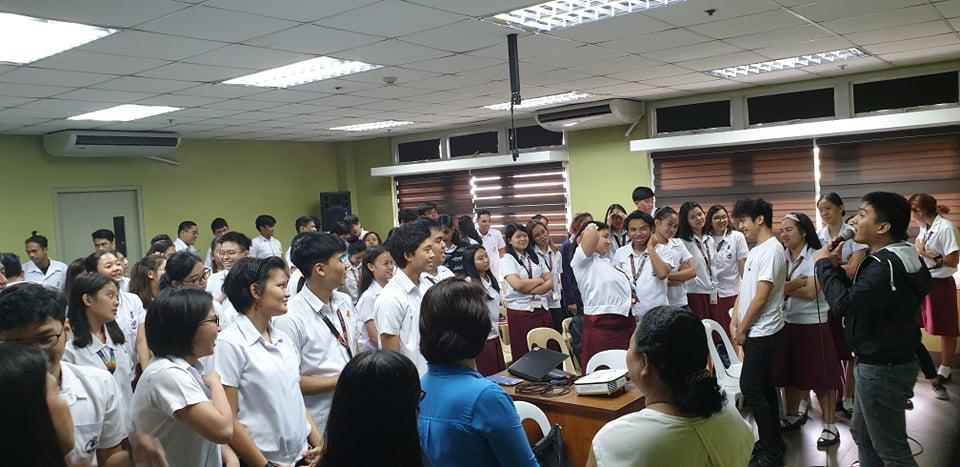
Heads Shoulders and? - Students were made to recite the human anatomy with a revised version of “Heads shoulders knees and toes” Photo Credit: Keio Guzman

A two-day Gender and Development Seminar (GAD) was held on August 29-30, for the graduating batch of the University of the Philippines Integrated School (UPIS) at the 4th floor Audio-Visual Room (AVR).

The seminar was held by the UP Diliman Gender Office (UPDGO) and the Office of Anti-Sexual Harassment (OASH), which aimed to spread awareness among the students regarding gender inequality, cases of sexual harassment around the campus, and steps to take in reporting such cases.

The UPDGO opened the first day of the GAD seminar with their presentation surrounding the concept of gender mainstreaming, where students were further taught about the issue of gender inequality and how their department promotes a gender-equal environment to the campus.

The second day of the GAD seminar was led by representatives of the OASH who defined sexual harassment, presented existing university policies, and cited cases of such issues around the campus. Teacher to student as well as student to student cases of sexual harassment were specified. The students were also taught how to identify if they are being sexually harassed, as well as know what they can do for themselves.

The seminars served as a pre-internship requirement for the students. //by Keio Guzmán